Table of Contents
ToggleThe convergence of LEGO building and gaming culture has produced some wild creations over the years, but few concepts capture the imagination quite like the LEGO gaming tournament truck, a mobile esports arena that brings competitive gaming anywhere you need it. Whether you’re planning a local tournament, creating content around gaming builds, or just want the coolest display piece for your setup, this brick-built powerhouse delivers on both form and function.
Unlike typical LEGO sets that sit static on a shelf, the gaming tournament truck combines motorized features, customizable gaming stations, and authentic tournament aesthetics into one modular build. It’s not an official LEGO product (yet), but the community-driven designs circulating in 2026 have refined the concept into something genuinely impressive. This guide breaks down everything from construction basics to hosting your own LEGO-themed esports event.
Key Takeaways
- A LEGO gaming tournament truck is a custom-built mobile esports arena that combines motorized features, customizable gaming stations, and realistic tournament details, typically measuring 18–24 inches and requiring 1,200–2,500 pieces depending on design complexity.
- Building a tournament-grade truck requires a solid Technic chassis, expandable side panels with motorized deployment, modular interior layouts, and realistic lighting setups to balance structural integrity, playability, and authentic esports aesthetics.
- Motorized features like LEGO Powered Up systems enable interactive functions such as side panel deployment, rear ramps, and synced RGB lighting sequences that create dramatic reveals and bring the static model to life.
- Hosting your own LEGO-themed gaming tournament works best with short-format games like Rocket League, Minecraft PvP modes, or Street Fighter 6 that finish quickly and pair well with the gaming truck’s visual centerpiece appeal.
- Strategic parts sourcing through BrickLink, Pick-a-Brick, and specialty vendors for lighting and custom decals significantly reduces costs, while consolidating orders and sourcing bulk common pieces from used lots maximizes budget efficiency.
- Thoughtful display and lighting setup—including eye-level positioning, dedicated spotlights, and integration with existing gaming aesthetics—transforms the LEGO gaming tournament truck from a model into a conversation piece and impressive social media asset.
What Is the LEGO Gaming Tournament Truck?
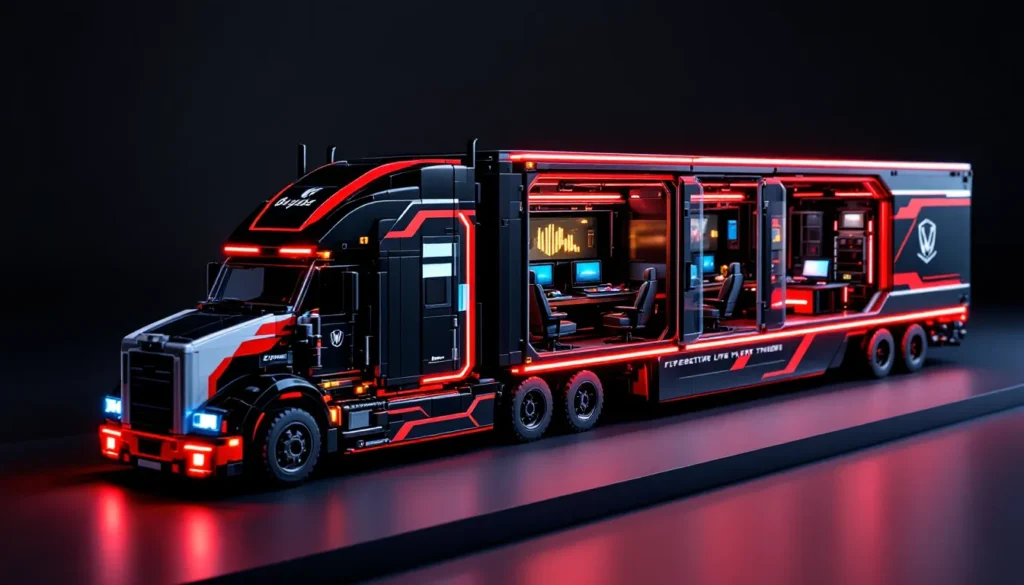
At its core, the LEGO gaming tournament truck is a custom-built mobile vehicle designed to house miniature gaming stations, lighting rigs, and tournament infrastructure, all constructed from LEGO bricks. Think of it as a scaled-down esports venue on wheels, complete with opening doors, deployable side panels, and interior gaming setups that mirror real-world tournament trucks used by organizations like ESL and BLAST.
The concept originated from MOC (My Own Creation) builders who wanted to merge their passion for competitive gaming with LEGO’s creative flexibility. Early versions were simple box trucks with printed gaming logos, but 2026 iterations feature working LED strips, motorized deployment mechanisms, and modular interiors that can be reconfigured for different game types.
Most builds measure between 18-24 inches in length, making them substantial display pieces without requiring an entire room. The exteriors typically feature sponsor decals (either custom-printed or stickered), antenna arrays, and satellite dishes that reference broadcast equipment. Inside, you’ll find rows of miniature gaming chairs, monitor banks, and even tiny server racks, all scaled to minifigure proportions.
Key Features and Specifications
The defining characteristics of a tournament-grade LEGO gaming truck include:
- Expandable side panels that fold out to reveal interior gaming stations (usually 4-8 individual setups)
- Motorized elements using LEGO Powered Up or Technic motors for doors, ramps, or lifting mechanisms
- Custom interior lighting via LEGO Light Kits or third-party LED strips (warm white for workstations, RGB for accent lighting)
- Modular flooring that allows swapping between different tournament layouts
- Detailed cab section with functional steering, opening doors, and driver/passenger minifigure seating
- Removable roof panels for easy access to interior components during photography or adjustments
Part counts typically range from 1,200 to 2,500 pieces depending on complexity. Advanced builds incorporate pneumatic systems for realistic suspension or hydraulic side panel deployment, though these require additional Technic components and drive up both cost and build time.
Design Philosophy Behind the Mobile Gaming Rig
The best LEGO gaming truck builds balance three priorities: structural integrity, playability, and visual authenticity. You want something sturdy enough to transport (if needed), interactive enough to justify the build complexity, and detailed enough that fellow gamers immediately recognize what it represents.
Designers often reference real esports production trucks from major events, studying how equipment is actually arranged in mobile broadcast units. This research informs decisions about cable management (yes, even in LEGO form), equipment placement, and how space is allocated between player stations and production gear.
The color blocking usually follows esports team palettes, lots of black, red, and white with accent colors matching specific organizations. Some builders go for a more neutral “broadcast truck” aesthetic with grays and blues, which photographs better but sacrifices some of that aggressive gaming vibe.
Building the LEGO Gaming Tournament Truck: Step-by-Step Overview
Constructing a gaming truck from scratch requires more planning than your typical LEGO set. There’s no instruction booklet (unless you purchase someone’s digital design), so you’ll need to approach this like a true MOC project with iterative design and problem-solving.
Start with the chassis and drivetrain. A Technic frame provides the strength needed to support upper structures and motorized components. Use at least 6-8 studs of width for stability, anything narrower will feel flimsy once you add walls and interior weight. The wheelbase should be proportional to the overall truck length: a good ratio is roughly 1:3 (if your truck is 24 studs long, position axles about 8 studs apart).
Once the base is solid, build up the cab section. This goes faster if you have reference photos of actual semi-truck cabs. Include a windshield that angles back slightly, side mirrors (1×1 round plates on small arm pieces work well), and a roof-mounted air intake or spoiler for that authentic long-haul look.
The cargo section is where creativity takes over. Most builders use a box construction with SNOT (Studs Not On Top) techniques for smooth exterior walls. Plan your side panel mechanism early, hinging outward is simpler than sliding panels, but sliding looks cleaner when deployed. Test the mechanism repeatedly before committing to the final wall construction.
Essential Pieces and Components You’ll Need
Here’s a breakdown by functional category:
Chassis and Structure:
- Technic beams (various lengths, primarily 9L, 11L, and 15L)
- Technic pins and connectors
- Large plates (8×16 or 6×12) for flooring
- Brick separators (you’ll need them)
Motorization:
- LEGO Powered Up hub and motors (1-2 medium motors minimum)
- Battery pack or rechargeable battery box
- Cables and extension wires
Wheels and Suspension:
- At least 6 wheels (some builds use 10 for full semi-truck authenticity)
- Axles (size 8 or 10 work for most scales)
- Optional: shock absorbers for working suspension
Interior Details:
- 1×1 tiles and plates in various colors (for monitors and control panels)
- Minifigure chairs (office chairs from modular buildings work perfectly)
- Transparent colored pieces (for screen effects)
- Printed tiles or stickers for sponsor logos
Lighting (Optional but Recommended):
- LED strip kits designed for LEGO
- CR2032 battery packs
- Light diffusion pieces (trans-clear plates)
You’ll also want a substantial collection of black, dark gray, and light gray bricks for the exterior. Buying in bulk from BrickLink or Pick a Brick can save significant money compared to acquiring these through sets.
Construction Tips for Stability and Functionality
The biggest structural challenge is preventing the cargo section from sagging or flexing. Reinforce the connection between chassis and walls with vertical Technic beams at regular intervals, every 6-8 studs along the length. These act like support columns in real architecture.
For motorized side panels, mount the motors low in the chassis rather than up in the walls. This keeps the center of gravity down and reduces stress on the motor mounts. Use gear reduction (a small gear on the motor driving a larger gear on the panel mechanism) to increase torque and prevent stalling.
Test weight distribution by setting the truck on a flat surface and gently rocking it. If it tips easily, you’ve got too much weight in the upper sections or the wheelbase is too narrow. Add counterweight to the cab or widen the track (distance between left and right wheels).
Cable management matters even at this scale. Route Powered Up cables along the chassis underside using 1×2 plates with clips, or hide them behind interior wall panels. Exposed cables look messy in photos and can snag during handling.
Customization Options to Match Your Gaming Setup
Personalization separates a good build from a showcase piece. If you main a specific game, incorporate its visual identity, Valorant’s angular red aesthetics, League of Legends’ gold and blue, or CS2’s tactical orange highlights.
Custom decals make a huge difference. Services like BrickStickers or Retrobricks can print logos, team names, or sponsor graphics on transparent backgrounds that adhere directly to bricks. For a DIY approach, waterslide decal paper run through an inkjet printer works, though it requires a clearcoat to prevent smudging.
Swap standard minifigures for custom ones representing pro players or your own gaming persona. Vendors on Etsy and BrickLink offer custom torso and head prints, including headsets, team jerseys, and even specific player likenesses.
Interior layouts can be reconfigured for different tournament formats. Remove a center row of stations to create a walking aisle for a “stage” setup, or pack in maximum stations for online qualifier vibes. Magnetic connections make swapping configurations quick, just embed small magnets in both the floor base and furniture pieces.
Technical Features That Bring the Tournament Truck to Life
The jump from static model to interactive build happens when you add motorization and electronics. LEGO’s Powered Up system (the current standard as of 2026) offers accessible entry into motorized functions without soldering or programming knowledge, though advanced builders can integrate Arduino or Raspberry Pi for custom control schemes.
Motorized Functions and Remote Control Integration
Side panel deployment is the most popular motorized feature. A single medium motor can operate both panels if you design a linked mechanism using Technic gears and axles running the truck’s length. The motor rotates an axle, which turns gears connected to both left and right panels simultaneously. Deployment takes 3-5 seconds and looks fantastic on video.
Rear ramp or door adds another dimension of interactivity. Use a worm gear setup for this, it provides excellent torque and importantly, the mechanism self-locks when power is off, preventing the ramp from falling open under its own weight.
Lighting sequences can be tied to motor controls through the Powered Up app. Program LEDs to activate when panels deploy, simulating the “power-up” sequence of a real tournament setup going live. RGB strips allow color shifts that match game phases (blue for setup, green for active play, red for finals).
The Control+ app (LEGO’s current interface) allows multi-function programming on smartphones or tablets. You can create custom control schemes where different buttons trigger specific motor sequences, or even set up autonomous routines that cycle through deployment and retraction.
For builders wanting more control, third-party solutions like BuWizz or SBrick offer increased power output and more sophisticated programming options. These are particularly useful if you’re running multiple motors simultaneously or need faster response times than Powered Up provides.
Interior Gaming Station Design Elements
Getting the interior to read as a genuine gaming setup requires attention to scaled-down details. Monitors are typically built from 1×2 tiles (black for bezels, trans-clear or trans-light-blue for screens). Angle them slightly toward the player position for realism.
Gaming chairs should swivel if possible, older office chairs from modular buildings have this function. Position them at slight angles rather than perfectly straight rows: real tournament setups have slight variations from cable management and player preference.
Keyboards and mice can be represented with 1×2 black tiles and 1×1 round plates respectively. It’s minuscule, but the brain recognizes the pattern. Some builders print tiny images of actual RGB keyboards onto 1×2 tiles for extra detail.
Cable runs underneath the gaming desks add authenticity. Use black string or rubber bands threaded through plate holes to simulate power and data cables. Don’t overdo it, three or four visible cables per station is enough to sell the effect.
The rear wall typically houses the production equipment. Stack 1×1 bricks with colored tiles to represent server racks, use transparent pieces for router indicator lights, and include a “broadcast station” with a larger monitor array. This is where tournament admins would monitor all player feeds simultaneously.
Lighting and Display Enhancements
Lighting transforms a LEGO build from toy to art piece. For the gaming truck, target three lighting zones: interior stations (bright, focused), exterior accent (colored, dramatic), and underglow (optional but looks incredible).
Interior lighting needs to be bright enough to showcase details without washing out colors. Warm white LEDs (3000-4000K color temperature) work better than cool white, which can look harsh in photos. Mount lights in the ceiling of the cargo section, angled slightly downward toward the gaming stations.
Exterior accent lighting benefits from color. Red and blue LEDs along the roofline or undercarriage give that esports energy. Some builders wire LEDs to blink or pulse using simple timing circuits, though this can be distracting if the truck is displayed in a bedroom or office.
Underglow, LEDs mounted under the chassis pointing downward, creates a floating effect when the truck sits on a dark surface. It’s pure aesthetics with zero functional purpose, which makes it perfect for a display piece. Use RGB strips so you can change colors to match whatever game you’re currently grinding.
How to Host Your Own LEGO Gaming Tournament
Once you’ve built the truck, why not make it the centerpiece of an actual gaming event? LEGO-themed tournaments bring a unique flavor to local gaming meetups, especially for communities that blend tabletop, building hobbies, and competitive gaming.
Setting Up Tournament Brackets and Competitive Rules
Keep the format simple for your first event: single-elimination brackets work well for 8-16 participants and finish in a reasonable timeframe (3-4 hours for most games). Double-elimination is better for competitive integrity but roughly doubles the match count, so plan accordingly.
Game selection matters. Choose titles with short match times, best-of-three rounds that finish in under 15 minutes. Rocket League, Brawlhalla, Street Fighter 6, and Mortal Kombat 1 all fit this profile. Battle royales like Fortnite or PUBG have too much RNG and time variance for tight tournament schedules.
For PC tournaments, esports organizers often recommend standardized settings to eliminate hardware advantages. Lock all games to 1080p resolution, disable graphic settings above “Medium,” and use the same peripheral setup for all players (same keyboard, mouse, and mousepad). This keeps focus on skill rather than equipment.
Prizing doesn’t need to be expensive. LEGO minifigures, custom-printed tournament tiles, or even bragging rights work fine. If you’re charging entry fees, make sure prize payouts are transparent before anyone registers, competitive gaming communities value fairness above all else.
Use bracket software like Challonge or Battlefy for match tracking. Both offer free tiers and automatically generate pairings, which saves tons of headache once matches start flowing. Display the bracket on a TV or monitor visible to all participants so everyone knows their next match.
Integrating the Truck Into Your Event Theme
The LEGO gaming truck should be the visual anchor of your event space. Position it prominently, on a raised platform or well-lit table, where participants see it immediately upon entering. The truck represents the tournament’s identity, so treat it like a trophy or championship belt.
Use the truck’s interior stations as the “official” tournament setups if you’ve built them to scale. For actual gameplay, arrange your real gaming stations to mirror the truck’s layout (rows, angles, spacing). This creates thematic cohesion that looks great in photos and helps with the event’s branding.
Create photo opportunities around the truck. Set up a designated spot with good lighting where winners can pose with the trophy while the truck sits in the background. These photos will circulate on social media and promote future events organically.
If you’ve motorized the truck, do a “grand reveal” at the tournament start where you deploy the side panels in front of everyone. It’s theatrical but effective, especially for first-time attendees who haven’t seen the build before. Small moments of spectacle help events feel special rather than just “some people playing games in a room.”
Consider thematic naming. Instead of “Round 1, Round 2,” use “Qualifier Stage,” “Truck Stop,” and “Grand Finals Deployment.” It’s corny but memorable, which matters for building recurring event attendance.
Best Games to Feature in LEGO-Themed Esports Events
Game selection can make or break a LEGO gaming tournament. You want titles that balance competitive depth with accessibility, finish matches quickly, and ideally have some visual or thematic connection to building, creativity, or block-based aesthetics.
PC Gaming Titles Perfect for Tournament Play
Minecraft is the obvious choice given the LEGO connection, both are about creative building with block-based systems. PvP-focused game modes like Bed Wars, Sky Wars, or UHC (Ultra Hardcore) deliver the competitive intensity needed for tournaments while staying on-brand. Match times vary, but you can structure rounds with time limits to keep things moving.
Rocket League works brilliantly for LEGO events even though no direct thematic link. Matches are exactly five minutes, skill expression is clear, and the game’s bright, clean aesthetic fits the playful vibe of a brick-built tournament. The car customization aspect also parallels LEGO’s creative freedom, many players even use vehicle designs that look deliberately blocky.
Portal 2 cooperative mode offers a unique tournament format. Teams race to complete puzzle chambers, with time determining placement. It’s less aggressive than traditional esports but rewards communication and creative problem-solving, very LEGO-appropriate skills. The pace is slower though, so this works better for smaller participant counts.
Trailmakers or Scrap Mechanic could work for more niche events. These vehicle-building games literally involve constructing functional machines from parts, mirroring LEGO Technic builds. Competitive modes exist (races, combat challenges), though the learning curve is steep for newcomers.
For traditional esports with proven competitive scenes, CS2 and Valorant remain strong choices. They lack thematic connection to LEGO, but the established rule sets, spectator-friendly gameplay, and familiar mechanics make running a smooth tournament much easier. Sometimes practicality trumps perfect theming.
Console and Mobile Games That Fit the Theme
Super Smash Bros. Ultimate is console tournament gold. Fast matches, huge existing competitive community, and accessible controls for casual players. The cartoony aesthetic and character variety align well with LEGO’s playful brand identity. Bracket management is straightforward since the FGC has decades of tournament experience.
Mario Kart 8 Deluxe keeps things light and inclusive. Even non-competitive players can participate without feeling completely outclassed, though skill still determines winners. The RNG from items adds variance that hardcore players might dislike, but for community-building events it prevents total dominance by single players.
Brawlhalla offers a free-to-play Smash alternative that runs on nearly any hardware. It’s available on PlayStation, Xbox, Nintendo Switch, and mobile, making it accessible for participants regardless of platform. The cartoonish, exaggerated character designs fit the LEGO aesthetic better than more realistic fighters.
LEGO Star Wars: The Skywalker Saga has multiplayer modes that could theoretically work for tournaments, though they’re not competitively balanced. This is more of a fun exhibition option rather than serious competitive play, but the direct LEGO connection is unbeatable if you want maximum thematic consistency.
Mobile gaming opens interesting possibilities for accessibility. Clash Royale tournaments have established formats and short match times (3-4 minutes). Brawl Stars works similarly, with 3v3 modes that finish quickly. Both are competitive enough for meaningful skill expression while running on devices most people already own.
Display and Showcase Ideas for Your LEGO Gaming Build
A build of this complexity deserves thoughtful presentation. The right display setup protects your work, enhances its visual impact, and makes the truck a conversation piece rather than just another model on a shelf.
Creating a Dedicated Gaming Room Setup
Position the truck at eye level when seated, this means shelf height of about 48-54 inches in most rooms. Too high and people strain to see interior details: too low and the truck gets visually lost among other furniture.
Integrate the truck into your existing gaming aesthetic rather than isolating it. If your setup features RGB lighting, sync the truck’s LEDs to match color schemes. For streamers, position the truck within camera view during broadcasts, it’s excellent background content that immediately communicates “this person is into gaming” without saying a word.
Acrylic display cases provide dust protection while maintaining visibility from all angles. Custom-cut cases run $80-150 depending on size, or you can DIY with sheets from hardware stores and acrylic cement. Include ventilation holes if the truck has always-on lighting to prevent heat buildup.
Surrounding context matters. Display related items nearby: esports team memorabilia, gaming peripheral boxes, or other LEGO gaming builds create a cohesive theme. Avoid mixing unrelated collections, a gaming truck looks odd next to medieval castle sets or city buildings.
Lighting the display area properly makes a massive difference. Dedicated spotlights (adjustable LED desk lamps work great) eliminate shadows and bring out color depth. Position lights at 45-degree angles from above rather than straight-on to create dimension and prevent flat-looking photos.
Photography and Content Creation Tips
When shooting the truck for social media or documentation, background matters as much as the build itself. A clean black or white poster board behind the truck eliminates distractions and makes the model pop. Some photographers use gaming-related backdrops, screenshots from tournaments, gaming event posters, or even printed circuit board patterns.
Shoot from slightly below eye-level to give the truck presence and drama. Shooting from directly above flattens the perspective and loses the sense of scale that makes these builds impressive. A 35-50mm equivalent focal length (on full-frame) captures the whole truck while minimizing distortion.
For detail shots, focus on specific features: deployed side panels with visible interior stations, motorized mechanisms in action, or custom decal work. These close-ups tell the construction story better than full-truck photos and perform well on platforms like Instagram where users scroll quickly.
Video content brings motorized features to life. Record deployment sequences in 4K at 60fps, then slow them to 50% speed in editing for dramatic effect. Add subtle sound effects, mechanical whirs, hydraulic hisses, to enhance the immersion. Even simple phone footage edited in CapCut or similar apps can look professional.
Time-lapse build videos perform exceptionally well on YouTube and TikTok. Set up a static camera position and photograph every 15-20 minutes during construction. The resulting video compresses hours of work into watchable 2-3 minute content that showcases the building process. Include the final reveal with lighting and motorization as the payoff.
Community Builds and Inspiration from Other Creators
The LEGO gaming tournament truck concept has evolved through community iteration rather than official LEGO releases. Builders share techniques, refine designs, and push creative boundaries in ways that single creators couldn’t achieve alone.
Rebrickable hosts several tournament truck MOC designs with full parts lists and building instructions. User “TechnicGamer” posted a particularly well-regarded version in early 2025 that uses a clever gear-driven panel system requiring only a single motor. The design has been remixed dozens of times, with builders adding their own tournament themes and motorization tweaks.
Instagram and TikTok accounts dedicated to LEGO gaming builds showcase remarkable variety. Some creators go hyper-realistic with weathering effects and extreme detail density. Others embrace a more stylized, almost retro-futuristic aesthetic with bold colors and exaggerated proportions. Both approaches work: the key is committing to a clear vision rather than mixing styles inconsistently.
YouTube channels like “Brick Builder Gaming” document full builds with narration explaining design choices. Watching these provides insight into problem-solving approaches, how experienced builders handle structural challenges, integrate electronics, and iterate when initial designs don’t work. The comment sections often contain additional tips from viewers who’ve attempted similar projects.
LEGO Ideas occasionally features gaming-related submissions, though a full tournament truck hasn’t reached the review stage yet. If the concept gained enough support (10,000+ votes), LEGO could theoretically produce an official set, though licensing complications around esports branding might complicate things. Still, community voting helps surface which designs resonate most broadly.
Local LEGO User Groups (LUGs) sometimes feature gaming builds at conventions or exhibitions. Seeing these in person reveals details that photos miss, the feel of motorized mechanisms, how lighting looks in actual room conditions, and the impressive scale that doesn’t always translate to screens. If there’s a LEGO convention near you, it’s worth attending specifically to study these advanced MOCs.
Discord servers and Reddit communities like r/lego and r/legotechnic offer real-time help when you’re stuck on technical problems. Post photos of your build-in-progress and experienced builders will suggest solutions. The community generally trends helpful rather than critical, especially when it’s clear you’ve put in effort before asking.
Where to Buy or Source LEGO Gaming Sets and Parts
Sourcing parts for a custom gaming truck build requires strategic shopping. Official LEGO retailers won’t stock the specific combination you need, so you’ll be mixing sources to optimize for cost, selection, and availability.
BrickLink remains the go-to marketplace for specific pieces. The seller network is massive, meaning you can usually find exact colors and parts. The trade-off is spending time across multiple sellers to minimize shipping, consolidating orders reduces costs significantly. Use the “Wanted List” feature to organize your needs, then let BrickLink’s algorithms suggest optimal seller combinations.
LEGO Pick-a-Brick (both online and in-store) works well for common pieces in standard colors. Prices are higher than BrickLink, but availability is guaranteed and shipping is predictable. The physical Pick-a-Brick walls in LEGO stores sometimes stock unusual pieces that don’t appear online, so check both if you have store access.
BrickOwl competes with BrickLink and occasionally has better prices on specific parts. The interface is cleaner and more modern, though the seller base is smaller. Cross-reference prices between platforms before committing to large orders.
For Powered Up components, official LEGO retail usually offers the best value since motors and hubs rarely go on sale elsewhere. Watch for LEGO VIP double-points promotions or holiday sales to stretch your budget. Third-party motor systems (BuWizz, SBrick) are available through their respective websites or specialty retailers.
Lighting kits come from specialized vendors. Game of Bricks, BrickStuff, and Light My Bricks produce LEGO-compatible LED solutions with detailed installation guides. These cost more than generic LED strips from electronics suppliers, but the ease of installation and LEGO-specific connectors justify the premium for most builders.
For bulk common pieces (plates, bricks, Technic beams), used LEGO lots on eBay or Facebook Marketplace provide massive savings. You’ll get tons of mixed pieces for cheap, though sorting takes time. This approach works if you need general building stock rather than specific rare parts.
Custom printed parts and decals require specialty services. BrickLink’s Designer Program allows purchasing community-designed printed elements, though selection varies. For true custom work, services like Firestar Toys, MiniFigs.me, or direct UV printing services can create exactly what you need. Budget $15-40 for small custom print runs depending on complexity.
Keep shipping costs in focus, they often exceed part costs for small orders. Consolidate purchases, reach minimum-order thresholds for free shipping when available, and plan builds around what you can source economically rather than requiring impossible-to-find pieces. If you’re building multiple MOCs simultaneously, combine parts lists to reduce total shipping charges across projects.
Conclusion
The LEGO gaming tournament truck represents where the hobby is heading, builds that transcend static display and become interactive, functional art pieces that integrate with other passions. Whether you’re in it for the construction challenge, the display value, or as a literal centerpiece for gaming events, the tournament truck concept offers creative depth that keeps evolving.
Don’t feel pressured to nail everything on the first build. Most impressive trucks you see online are third or fourth iterations where the builder refined techniques and fixed issues from earlier versions. Start with a simpler design, get the core mechanisms working, then expand with lighting, motorization, and custom details as your skills and parts collection grow.
The community around LEGO gaming builds continues to grow, with gaming culture coverage helping bring attention to the intersection of building hobbies and competitive gaming. As esports becomes more mainstream and LEGO’s adult fan base expands, expect to see more sophisticated builds and possibly even official sets exploring this space. Until then, MOC builders are pushing the boundaries of what’s possible with bricks, motors, and imagination.